India and Japan move to shield supply chains and reopen their trade pact
At the 16th annual summit the two governments tied the economic relationship to supply-chain resilience, energy security and a ten trillion yen investment target.
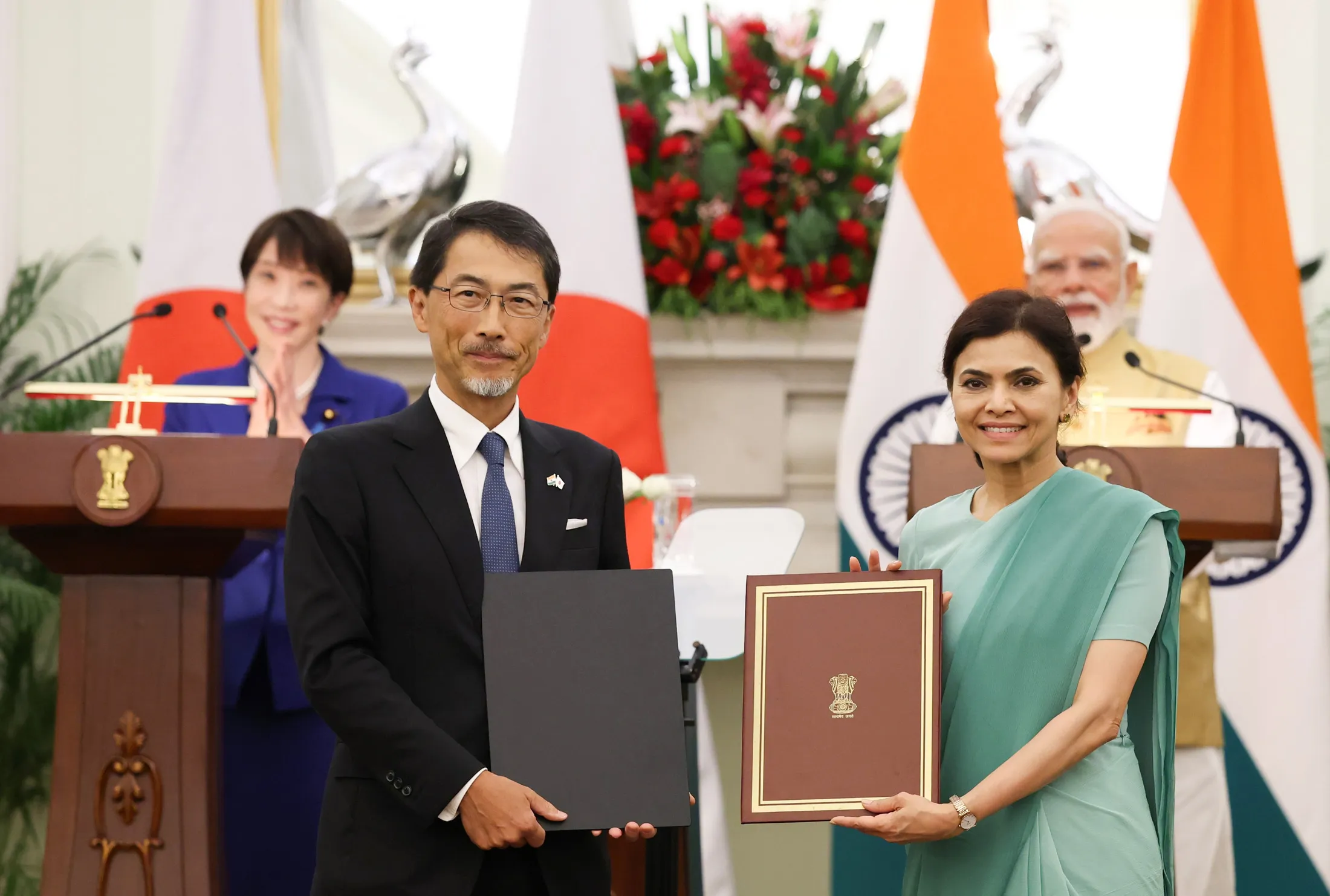
India and Japan used their 16th annual summit to put economic security at the centre of the relationship, adopting a Joint Declaration on Economic Security Cooperation that commits both governments to project-based work in semiconductors, critical minerals, information and communication technology, clean energy and pharmaceuticals.
The declaration, one of 16 outcome documents from Prime Minister Sanae Takaichi’s visit to New Delhi, follows the Economic Security Initiative the two countries launched at the previous summit. Since then they have held their first Private-Sector Economic Security Dialogue and a second round of the government dialogue, according to the joint statement issued on 2 July.
Both governments recorded what the statement called “grave concerns” over economic coercion and “arbitrary export restrictions” that can break supply chains in critical minerals and industrial sectors, along with price manipulation. Without naming any country, they said supply chains should be “diversified, resilient and reliable” and should “avoid reliance on any one country”.
Reopening CEPA
The two sides agreed to accelerate a review of the Comprehensive Economic Partnership Agreement, the bilateral trade pact they signed more than 15 years ago. The statement said the review should improve how the agreement is implemented and used, and make it “more forward-looking”, reflecting Indian concern that the deal has not kept pace with trade.
On investment, the leaders assessed progress towards the ten trillion yen target Japan set for its investment in India at the 15th summit in 2025. They agreed to use the fast-track mechanism under the India-Japan Industrial Competitiveness Partnership to improve conditions for Japanese firms, and endorsed work in logistics, textiles, food processing, agriculture, automobiles and industrial capital goods.
The Japanese side welcomed steps that let its banks and financial institutions expand in India, and both governments backed more cooperation on payment systems, including transactions in local currencies.
Energy and smaller firms
The two governments adopted a separate Joint Statement on Energy Resilience between India’s Ministry of Petroleum and Natural Gas and Japan’s Ministry of Economy, Trade and Industry. It covers strategic stockpiling of crude oil and petroleum products and joint investment across the shipping route that carries energy. Takaichi affirmed her support for India joining the International Energy Agency.
Both leaders pointed to the Strait of Hormuz, through which much of India’s oil passes, and stressed the need to keep commercial vessels moving. On clean energy they welcomed a Cooperative Biogas for Growth Initiative that targets 1,000 biogas and organic fertiliser plants across India through dairy cooperatives, and reaffirmed a clean ammonia project in Odisha.
For smaller companies, the two sides inaugurated an India-Japan SME Forum and pointed to India’s Tier-II and Tier-III supplier ecosystem as the next place for Japanese firms to invest. They signed a Memorandum of Cooperation on a Next Generation Mobility Partnership covering rail, automobiles, road infrastructure, aviation, shipbuilding, ports and logistics, framed around making goods in India for export to third countries.
The summit also reviewed four Japanese-backed development projects: Mumbai Metro Line 11, Bengaluru Metro Phase 3, healthcare and education work in Maharashtra, and horticulture in Punjab.
Sources: Ministry of External Affairs / Prime Minister’s Office, “16th India-Japan Annual Summit Joint Statement” (Release ID 2280587) and “List of Outcomes” (Release ID 2280591), 2 July 2026.