India and Japan open an AI research partnership and advance a co-developed naval antenna
Technology ran through much of the 16th annual summit, from AI and quantum research to a lunar mission and the UNICORN naval antenna the two countries are co-developing.
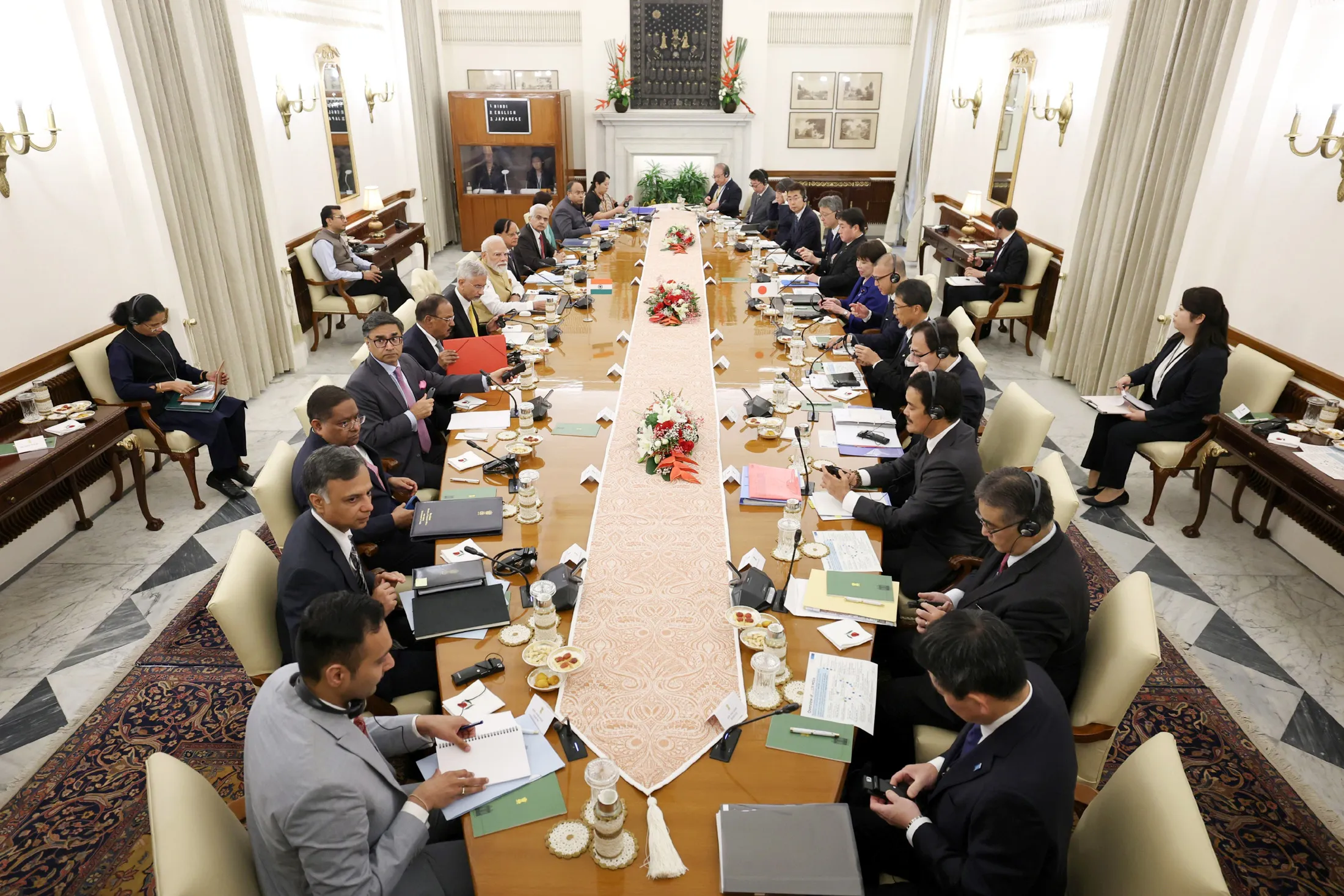
India and Japan adopted a Joint Statement on Cooperation in Artificial Intelligence at their 16th annual summit, describing it as a step towards a strategic research and development partnership across what the two governments called “the entire AI technology stack”.
The statement, released on 2 July during Prime Minister Sanae Takaichi’s visit to New Delhi, builds on the India-Japan AI Cooperation Initiative and marks the first meeting of an India-Japan AI Strategic Dialogue. Both governments tied their work to the Hiroshima AI Process and the New Delhi Declaration on AI Impact, and set the goal of “safe, secure, trusted, inclusive, and human-centric AI”.
Research tie-ups
The list of summit outcomes recorded several institution-level agreements. India’s IndiaAI Mission and Japan’s Ministry of Economy, Trade and Industry signed a Memorandum of Cooperation linking IndiaAI with Japan’s GENIAC programme, covering matchmaking between firms, policy exchanges and access to computing resources for joint projects.
On large language models, IIT Bombay, the BharatGen Technology Foundation and Japan’s National Institute of Informatics agreed to work on models built for scientific reasoning, and the Indian startup Sarvam AI signed an agreement with Japan’s Preferred Network covering foundation models and the wider AI stack.
The two governments also signed research agreements outside AI. India’s Centre for Cellular and Molecular Platforms and the National Centre for Biological Sciences each agreed to work with Japan’s RIKEN on life sciences and neuroscience. India’s Department of Science and Technology and Japan’s Cabinet Office signed a letter of intent on quantum technologies, and both sides noted progress on LUPEX, the joint lunar polar exploration mission run by ISRO and Japan’s space agency, JAXA.
The UNICORN antenna
On defence technology, the joint statement said the two sides had reached agreement in principle on the remaining technical details of the Unified Complex Radio Antenna, known as UNICORN, an integrated naval communications antenna developed in Japan. The leaders said they expected the project to conclude early and, under the framework of Make in India, agreed to look at further defence-technology work.
Modi welcomed Japan’s review of its three principles on transferring defence equipment and technology, a set of rules that has limited how much military hardware Japan can export. A looser reading would let the two countries pursue more joint projects.
The summit also produced technology-adjacent pacts on batteries, pharmaceuticals and medical devices, and mineral exploration, along with an agreement between India’s National Internet Exchange and Japan’s network information centre on IPv6 adoption and internet governance.
Sources: Ministry of External Affairs / Prime Minister’s Office, “16th India-Japan Annual Summit Joint Statement” (Release ID 2280587) and “List of Outcomes” (Release ID 2280591), 2 July 2026.