India and Japan sign 16 agreements as Takaichi makes her first Delhi visit
Prime Minister Sanae Takaichi's first official visit to India ran from 1 to 3 July. She and Prime Minister Narendra Modi organised the partnership around three priorities: defence and security, economic ties, and people-to-people exchange.
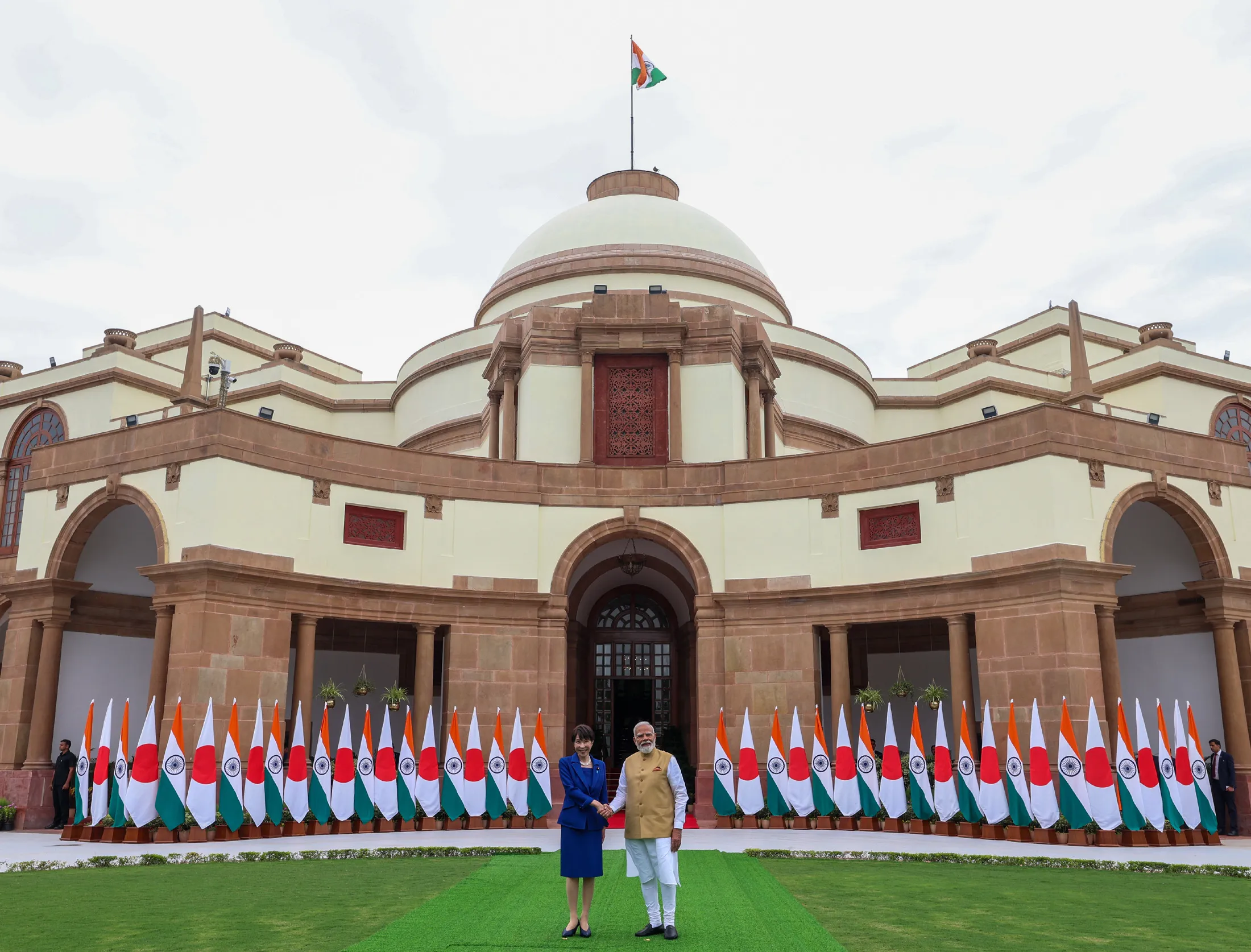
Prime Minister Sanae Takaichi of Japan paid an official visit to India from 1 to 3 July for the 16th India-Japan Annual Summit, her first visit to the country since taking office. She came at Prime Minister Narendra Modi’s invitation with a delegation of senior officials, chief executives and industry leaders, according to the joint statement issued by the two governments on 2 July.
The two leaders adopted 16 outcome documents and agreed to organise the relationship around three priorities: defence and security cooperation; economic partnership, including economic security, energy resilience, technology and innovation; and people-to-people exchange. They described India and Japan as “natural and indispensable partners” and reaffirmed their Special Strategic and Global Partnership.
Defence moves forward
The leaders directed their ministers to hold the fourth round of the India-Japan 2+2 foreign and defence ministerial meeting in Tokyo before the end of 2026. The joint statement recorded the two navies’ JAIMEX 25 exercise and Japan’s participation in India’s International Fleet Review 2026 at Visakhapatnam.
On equipment, the statement said the two sides had reached agreement in principle on the remaining technical details of the Unified Complex Radio Antenna, known as UNICORN, an integrated naval communications antenna developed in Japan. The leaders said they expected the project to conclude early and agreed to look at further defence-technology projects. Modi welcomed Japan’s review of its three principles on transferring defence equipment and technology.
The two sides also agreed to deepen maritime security cooperation through more exercises, satellite-based maritime domain awareness, and naval maintenance, repair and overhaul work, along with defence-equipment and technology cooperation under Make in India.
The economic core
Modi and Takaichi adopted the India-Japan Joint Declaration on Economic Security Cooperation, aimed at project-based work in semiconductors, critical minerals, information and communication technology, clean energy and pharmaceuticals. Both governments raised what the statement called “grave concerns” over economic coercion, arbitrary export restrictions on critical minerals, and price manipulation, and said global supply chains should not rely on any one country.
On investment, the leaders reviewed progress towards the ten trillion yen target that Japan set for its investment in India at the 15th summit. They agreed to accelerate a review of the Comprehensive Economic Partnership Agreement, the bilateral trade pact signed more than 15 years ago, to make it more useful and forward-looking.
They also adopted a Joint Statement on Energy Resilience between India’s petroleum ministry and Japan’s Ministry of Economy, Trade and Industry, covering strategic petroleum reserves and joint investment across the shipping route for energy. Takaichi backed India’s bid to join the International Energy Agency.
Rail, AI and research
The leaders reaffirmed the Mumbai-Ahmedabad high-speed rail line as the flagship of the partnership. Takaichi said Japan understood India’s target of starting commercial services on priority sections in 2027 and would extend the cooperation needed, and both sides noted the plan to introduce the E10 Shinkansen train. Modi invited Japanese firms to bid for future corridors in India’s planned 7,000-km high-speed network.
On technology, the two governments adopted a Joint Statement on Cooperation in Artificial Intelligence, convened their first AI Strategic Dialogue, and signed research tie-ups on large language models. They also welcomed the launch of a Cooperative Biogas for Growth Initiative that targets 1,000 biogas and organic fertiliser plants across India through the country’s dairy cooperatives.
The regional agenda
On the wider region, the statement recorded shared concern over the situation in the East China Sea and South China Sea, opposition to “any unilateral actions” that change the status quo by force, and support for freedom of navigation through the Strait of Hormuz. The leaders backed the Quad and agreed to prepare for the next leaders’ summit, and said they would begin preparations for a trilateral track-1.5 policy dialogue with the Philippines.
Both governments confirmed they would mark 2027, the 75th anniversary of diplomatic relations, as the India-Japan Year of Shared Horizons.
Sources: Ministry of External Affairs / Prime Minister’s Office, “16th India-Japan Annual Summit Joint Statement” (Release ID 2280587) and “List of Outcomes: Prime Minister of Japan’s visit to India for the 16th India-Japan Annual Summit” (Release ID 2280591), 2 July 2026.